
Mental health at work is still too often treated as a personal matter: something to be addressed through resilience training, an employee assistance programme or a wellbeing campaign. These initiatives may be valuable, but they do not answer the most important organisational question: what is it about the way work is designed, managed and experienced that may protect—or undermine—people’s health and safety?
Stress, fatigue, conflicting demands, lack of control, interpersonal tension and fear of speaking up do not remain confined to an employee’s inner life. They influence attention, judgement, communication and risk perception. In safety-critical environments, their effects may be immediate. In other settings, they may appear gradually through disengagement, sickness absence, turnover, conflict or deteriorating performance.
This is why holistic worker welfare should not be positioned at the margins of an organisation’s health, safety and environment strategy. It belongs at its centre.
The regulatory direction in both the European Union and Saudi Arabia reinforces this shift. The two systems are not identical, and their legal requirements should not be conflated. Yet both increasingly support a preventive approach in which worker health is broader than the absence of physical injury.
Psychosocial risk is an organisational risk
Psychosocial risks arise from the design and management of work and from its social context. Common examples include excessive or conflicting demands, insufficient staffing, low autonomy, unclear roles, job insecurity, poor support, harassment, violence and an organisational culture in which workers do not feel able to raise concerns.
These are not simply individual vulnerabilities. They are conditions of work. Their prevention therefore requires more than asking workers to become more resilient.
A holistic approach examines the full system:
- how workloads and schedules are determined;
- whether roles, responsibilities and priorities are clear;
- whether managers recognise early warning signs;
- whether workers can report concerns without fear of blame or retaliation;
- how fatigue, emotional demands and organisational change are managed;
- whether support is accessible, confidential and adapted to the workforce;
- and whether lessons from incidents, near misses and employee feedback lead to organisational action.
Personal support remains important. However, counselling should complement—not substitute for—prevention at source.
The European Union: psychosocial risks within the duty of prevention
The foundation of European occupational safety and health law remains Framework Directive 89/391/EEC. It requires employers to ensure workers’ safety and health in every aspect related to work, assess risks and apply general principles of prevention.
These principles include avoiding risks, combating them at source, adapting work to the individual and developing a coherent prevention policy covering technology, work organisation, working conditions, social relationships and the influence of factors related to the working environment.
Although the Directive predates today’s workplace mental-health vocabulary, the European Agency for Safety and Health at Work states explicitly that managing psychosocial risks is a legal requirement under this framework.
Its current guidance emphasises identifying these risks, eliminating them where possible and otherwise reducing them through organisational and technical measures—not relying solely on individual coping strategies.
The EU Strategic Framework on Health and Safety at Work 2021–2027 further recognises psychosocial and ergonomic risks as increasingly important in a changing world of work.
Digitalisation, remote and hybrid work, constant connectivity, restructuring and new forms of management may create flexibility, but they can also intensify work and blur the boundaries between professional and private life.
In 2023, the European Commission’s comprehensive approach to mental health placed mental health on an equal footing with physical health and identified psychosocial risks at work as a specific area for action.
More recent work by the European Agency for Safety and Health at Work has continued this direction, including practical guidance for supporting workers experiencing mental-health difficulties and the 2025 OSH Pulse research programme.
The Healthy Workplaces Campaign for 2026–2028 is also dedicated to mental health and psychosocial risks at work.
The implication for organisations is significant: offering wellbeing benefits is not, by itself, evidence that psychosocial risks are being properly managed. Employers need a structured process that connects risk assessment, worker participation, preventive action, leadership accountability and review.
National legislation and enforcement still vary across EU Member States. Companies operating in several countries must therefore consider both the European framework and the specific rules, case law and collective arrangements applicable in each jurisdiction.
Saudi Arabia: a rapidly developing occupational health and safety architecture
Saudi Arabia’s occupational safety and health system has developed considerably as part of the Kingdom’s broader labour-market transformation and Vision 2030.
Chapter Eight of the Saudi Labor Law establishes provisions relating to worker protection, safety, health and social care.
It requires employers to take necessary precautions to protect workers from hazards, occupational diseases and machinery; maintain appropriate workplace conditions; inform workers about occupational risks; and provide relevant protective measures and training.
Working-time, rest and leave provisions elsewhere in the labour framework also contribute to worker protection, even where they are not labelled as mental-health measures.
An important development is the National Policy for Occupational Safety and Health, approved in 2021.
Its preventive orientation is broader than a traditional accident-control model. The National Council for Occupational Safety and Health describes the policy as supporting the protection, preservation and promotion of workers’ physical, mental and social health, alongside the assessment and elimination of hazards at their source.
The establishment of the National Council for Occupational Safety and Health in 2022 strengthened the governance of this national system.
The Council is intended to coordinate government bodies and consult workers, employers and their representatives while improving compliance with occupational safety and health standards.
The Saudi labour framework was also updated through amendments issued in 2024 and made effective, together with revised implementing regulations, on 19 February 2025.
The reforms modernised a wide range of employment provisions and were presented by the Ministry of Human Resources and Social Development as supporting a safer, more attractive and more stable labour market.
They should not be described as creating an EU-style standalone psychosocial-risk regime. Nevertheless, they form part of a wider regulatory trajectory focused on employment quality, worker protection and organisational responsibility.
Other Saudi laws are also relevant to the psychosocial environment. The Anti-Harassment Law protects dignity and privacy and seeks to prevent and punish harassment, including conduct occurring in the workplace.
Effective prevention therefore requires more than a written policy: workers need trusted reporting channels, fair investigations, protection from retaliation and visible leadership commitment.
Saudi Arabia’s framework should be applied with careful attention to the latest official regulations, ministerial decisions, sector requirements and implementing guidance. Organisations should obtain local legal advice when determining their precise obligations.
Different legal routes, a shared preventive logic
It would be inaccurate to suggest that European and Saudi legislation impose the same detailed obligations concerning psychosocial risks.
The European framework makes the connection between psychosocial hazards and the general occupational risk-assessment duty especially explicit. Saudi Arabia’s framework is developing through the Labor Law, national policy, institutional governance and complementary protections.
However, a shared direction is visible: occupational health and safety is moving beyond a narrow focus on accidents and physical exposure.
Prevention increasingly requires attention to the human, social and organisational conditions in which work takes place.
For international employers, the goal should not be to copy and paste one jurisdiction’s compliance programme into another. A stronger approach combines:
- a common global commitment to physical, psychological and social health;
- compliance with the specific law of each country;
- culturally and linguistically appropriate worker consultation;
- confidential and credible reporting mechanisms;
- locally relevant indicators and interventions;
- and consistent senior-level accountability.
From compliance to a culture of care and safety
Organisations can begin with five practical commitments.
Include psychosocial hazards in risk assessment
Assess workload, staffing, schedules, role conflict, emotional demands, interpersonal behaviour, organisational change and psychological safety alongside physical hazards.
Use several sources of evidence: worker consultation, absence and turnover data, incident investigations, occupational-health information and anonymous surveys.
Act on the organisation of work
If the source of harm is chronic understaffing, contradictory priorities or an unsafe reporting culture, a mindfulness course will not resolve it.
Preventive action may require changes to workload, resources, supervision, decision-making or team practices.
Build psychologically safe reporting systems
Workers need to know where to raise a concern, what will happen next and how confidentiality and protection from retaliation will be handled.
Managers must be trained to receive concerns without minimising, diagnosing or blaming.
Connect mental health with safety learning
Incident and near-miss reviews should consider fatigue, workload, communication, leadership and team dynamics without turning them into excuses or sources of individual blame.
These factors are often part of the system that produced the event.
Measure prevention, not only distress
Sickness absence and survey scores are lagging indicators.
Organisations should also monitor whether risk assessments lead to action, whether employees participate in solutions, whether managers follow up concerns and whether corrective measures are completed and reviewed.
A leadership question
Holistic worker welfare is not about promising that nobody will experience stress or mental-health difficulties. Nor does it require employers to become clinicians.
It requires organisations to recognise the health consequences of how work is designed and led, to prevent avoidable harm and to respond appropriately when difficulties arise.
The most mature organisations will not ask only, “What support can we offer this employee?” They will also ask, “What is happening in our system, and what must we change?”
That shift—from individual support alone to organisational prevention—is where mental health, worker welfare and safety culture truly meet.
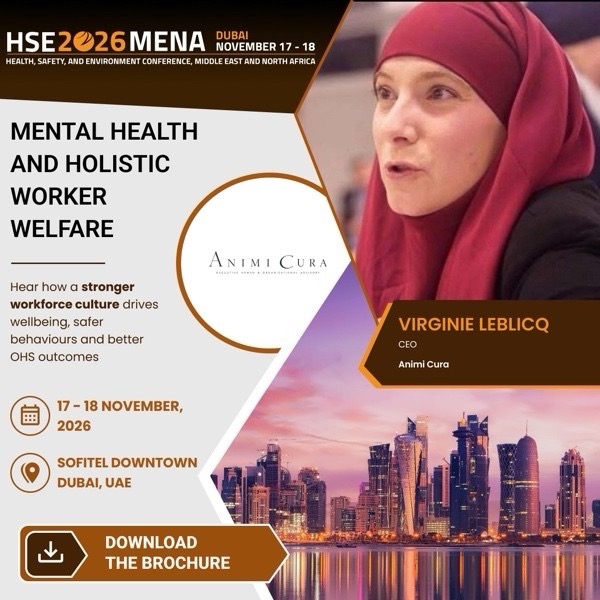
Virginie Leblicq is a clinical psychologist, judicial expert and CEO of Animi Cura.
She will speak on “Mental Health and Holistic Worker Welfare” at HSE MENA 2026, held on 17–18 November 2026 at Sofitel Dubai Downtown, United Arab Emirates.
HSE MENA 2026
17–18 November 2026
Sofitel Dubai Downtown
Dubai, United Arab Emirates
This article provides general information and does not constitute legal advice. Legal obligations may vary by jurisdiction, sector, workforce and the facts of a particular situation. The regulatory references were reviewed on 12 August 2026.